|
Lesson 6
Writing the Offer
General
In all respects, the property checks out as
being one that you want to own
- what next? Well, you need to write a purchase contract. This
documents is also sometimes called a purchase agreement or contract to purchase,
but what is in it is a lot more important than its name.
There are a number of elements to a legal contract to purchase real
estate. Basically, they are:
Although you will not usually sit around a conference
table negotiating various terms and conditions of your purchase contract, you
should be aware of negotiation principles when you write your offer. You
will almost certainly negotiate after you have made your offer. Unless
your purchase offer is ridiculously out of line with value or other issue to the
degree that it makes the seller mad, you should expect a counter offer from the
seller. It is likely that you will get a counter offer even if you offered full price
because some of the contingencies or other issues that you included will
probably be objectionable to the seller or his agent. Many of the same
principles apply whether you are sitting across the table from the seller or
instead are writing your original offer or writing a counter offer to his
counter offer.
Contract Forms
Most real estate agents who are representing a buyer
will utilize a
purchase contract that is (1) their firm's custom form, if a large company or a
franchise such as REMAX or Century 21, or (2) their state's Association of Realtors
form. If you are working without an agent, you have the choice of
obtaining a form of the seller's agent if there is one (and there usually
is), whichever type that is, or obtaining an Association of Realtors form
yourself. One of the potential problems with using the custom form of a
large company is
that it may contain a whole lot of references to the company name.
Accordingly, of the two choices, you usually be better off using the state
Association of Realtors' form.
An alternative is a form of a reputable independent publisher such as California's first
tuesday. Unless you are capable of judging the adequacy of the
independent publisher form, assuming there is a good one available for your
state, it is usually safest to use the Association of Realtors' form because
state associations tend to employ competent attorneys for drafting forms and they
are usually kept up to date regarding the latest statutes and Court decisions.
One potential problem in getting a form from the
seller's agent is that the agent will likely want you to let him
help you fill out the form. Remember that the seller's agent
wants badly to make the deal because he will make a lot of money no matter what
price the property sells for and whether it's a good deal for either the buyer
or the seller. Accordingly, if you're not sure that you can hold your own
against the agent and won't let him influence your offer (probably almost
impossible), don't let him work with you on the contract. For the same
reason, you need to hold your own in filling out the form along with your own
agent when you have one.
The form, from whatever source, will have various and sundry
boiler plate clauses regarding financing and other conditions and
contingencies. There is nothing wrong with using these clauses where they
meet your own requirements. However, do not be intimidated into using a
clause that does not say exactly what you want. Do not hesitate to add an addendum
that contains the exact customized clauses that you need.
Be sure to line out the boiler plate clauses and refer to the addendum for each
of the clauses that you wish to replace or modify. Due to limited space on
the form and for clarity it is usually best to write a new clause on the
addendum rather than mark up an existing clause except for very minute changes
(e.g., changing the number of days from 7 to 10). Be sure that both
parties initial every single markup on the contract. Example
of an addendum.
Price
When writing the offer, you need to decide what you are willing
to pay for it. As previously stated in Lesson 5, a good
understanding of valuation is required before applying the information of this
course and the subject is covered in detail by our Valuing
Income Property e-course.
Deposit
Cash deposits are customary, but smart
buyers don't have to operate according to custom. The seller wants the buyer to put up a cash deposit to keep
him from backing out of the deal, because when a contract for purchase has
been negotiated and signed, the seller is actually granting the buyer an
exclusive option to purchase the property, subject to the terms and conditions
contained in the agreement. So, the buyer is getting a lien on the property
subject to those conditions. The seller needs something in return, right?
Sure, but why should it have to be cash? How about a promissory note with zero
interest for earnest money. Or you might execute a second mortgage or trust
deed on another property as deposit money. Use your imagination and keep your
money working for you where it is. There is other important reason to
avoid cash deposits, if possible. In the event of a deal that falls apart
with accusations of fault against each party, it is harder for the seller to
collect from you, and less likely that he will try, compared to your money being
in escrow. Keep in mind, though, that a legitimate escrow company will not
usually release money to the seller (or the buyer) if there is a disagreement
regarding it's release that is not resolved to the satisfaction of their
attorney by reading the contract.
Personal Property

If there is any personal property included in the sale or
that you want included in the sale, be sure that the contract includes
it. It is sometimes best to have a separate agreement in every offer that
covers any and all personal property, but make it an intrinsic part of the
real estate transaction, in order to prevent a lender from subtracting the value from
their loan commitment. There are several advantages to a buyer. For example:
- Personal property has a much faster deprecation schedule
for tax purposes. If you have a seller-financed agreement, allocate a
large part of the purchase to personal property and amenities.
- The personal property must be inventoried and listed,
thereby guaranteeing that you actually get what you have agreed to pay for.
- Have a right to inspect all of the property just prior to
closing. Even minor damage to incidentals can be deducted from the
seller's proceeds.
Instruct the closing agent that you want a bill of sale for
all the personal property listed in inventory. It will be very helpful in the
event of an IRS audit and will also assist you in making a case for a lower
property assessment with the local tax assessor or property tax appeal board.
Contingencies
General
Contingencies are
very important and it is important that they be properly written. Be sure that your purchase contract makes
contingencies out of all inspections and allows adequate time to get the results
of the inspections, taking into account inspector scheduling, holidays, weekends,
weather; time to analyze the reports; and time to exercise a contingency if
necessary. There are a number of general principles that you
should follow when writing contingencies into your offer.
- Write all contingencies to require written approval of buyer
(as opposed to automatically approved if not disapproved in writing) in order to eliminate
possible loss of contingencies due to oversight or running out of time.
You can then ask for a contract amendment to allow for a little more time.
- For those contingencies
that have a cost (e.g., physical inspections and Phase One Report) it is
usually in the buyer's best interest to bear the cost and reduce the offered price
accordingly. The reason for this is two-fold. First, it is usually
better that the vendors to be hired are the agents of the buyer rather than of
the seller for several reasons. Second, after the offer has been accepted, you may, for one reason or another, decide
that there is no need to pay for a
certain inspection or may be able to get it done for much lower cost than
expected. If the seller is to pay for the inspections, he will have to
keep his price high enough to cover the costs and will likely use worst case
high amounts for all of the items.
- Make all time periods for contingencies requiring information from the
seller start with receipt of that information rather than from date of the
contract acceptance. That way your time is not shortened due to his
delay.
- Base the time period for each contingency on the total of time required to
schedule a vendor, time for the vendor to provide his report, time to
analysis report, and time to get a discrepancy report to the seller or into
escrow - then add 20 to 30 percent.
- To the degree possible, schedule period limits of inspections in order of importance
relative to decision making.
- State all time limits as number of calendar days rather than business days
in order to avoid any confusion over what is or is not a business day. Specific dates may be used for items that do not require action
by the seller, but should not be used if related to
a relatively short time period because any delay in execution of the contract
itself can
severely reduce the period remaining.
A typical list of contingencies might be
as follows:
| INSPECTION
PERIOD. Contingency expirations for various
disclosures and inspections are listed below. Buyer shall
deliver to "Real Estate Agent," as agent of Seller, written notification
of satisfaction regarding any disclosure or inspection within the
time specified. If written notice of satisfaction for an item
is not received within the specified time, that item shall be deemed
disapproved. |
| 1 |
Size Measurements |
7 calendar days after acceptance |
| 2 |
Lease Documents |
15 calendar days after
receipt |
| 3 |
Financial Records |
15 calendar days after
receipt |
| 4 |
Estoppel Certificates
(non-lender) |
5 calendar days after
receipt of executed forms |
| 5 |
Preliminary Title Report
(w/docs) |
10 calendar days after
receipt of report and all related documents |
| 6 |
Physical Inspections &
Tests |
25 calendar days after
acceptance |
| 7 |
Boundary Survey |
20 calendar days after
acceptance |
| 8 |
Phase 1 Environmental
Report |
30 calendar days after
acceptance |
| 9 |
All other matters (except
financing) |
20 calendar days after
acceptance |
|
10 |
Financing |
30 to 60 calendar days after receipt of all
documentation required by the lender (e.g., leases, financial data) |
Note that contingencies requiring
action first by the seller have periods starting from receipt of the items from
the seller, whereas, other items that are completely up to the buyer have
periods starting from date of acceptance. Note also that calendar days are
specifically defined rather than business days to avoid any confusion about weekends or
holidays, but you must take into account the actual business days when vendors
will actually be working when setting the limits. For example, you will
need a lot more calendar days for contingency periods that include the
Christmas/New Years holidays or the Thanksgiving holiday than for periods that
contain no holidays. The number of days that should apply to each of your
contingencies depends upon the type and complexity of the property. If you
are buying single-family home or a duplex and the only physical inspection will
be performed by a property inspection service that you have already determined
can provide the written report within 5 days of notice, you may consider 10 days
an adequate period for physical inspections. However, if you are buying an
older shopping center and will require separate inspections of the roof,
heating/cooling, plumbing, and electrical systems as well as a check for
asbestos, you may want to have at least 30 days for physical inspections.
The best procedure in setting the periods is to contact a couple of vendors (or
the one that you usually use) for each inspection item prior to writing the
offer and ask what kind of
turn-around you can expect at this time considering their work load, the
weather, and any other factors that might apply to that inspection item.
Financing
Unless you're paying cash and the money is in
your bank account, a financing contingency is very important. Be specific regarding
the maximum acceptable interest rate,
discount points, and other costs as well as the minimum number of years of the
loan that you are willing to accept.
Also, specify
that it will be a loan from a legitimate lender (no loan sharks) and specify a fixed
interest rate if you are unwilling to take a variable rate loan. Finally,
be sure it is clear that your inability to obtain financing meeting your
criteria is a complete failure of the contingency.
Legal Issues
For reasons discussed in the previous lesson, the contingency should state that all units are legal, both as to zoning and to building codes.
Licenses & Permits
Require that all
required licenses and permits are currently in place and there are no violations
pending. If an inspection will be required in order to obtain missing license or
permit, the contingency should require that it be completed immediately and that
correction of any deficiencies uncovered by the inspection shall be at the
expense of the seller.
Title Report & Title
Insurance
Require delivery of a preliminary title report or
chain of title report as soon as possible. You as buyer usually have the
right to choose the title company or attorney and should do so. You can
ask ahead of time what the maximum period will be required for provision of the
report. State that legible copies of
all documents referred to in the report are to be provided and that contingency period
starts only when all documents have been provided. It is not unusual that
preliminary title reports have errors, so require that the contingency be extended by any delay resulting from errors or omissions in the report including
the need for additional document copies.
If in a jurisdiction where title insurance is
available, require that extended coverage be provided, rather than the basic,
even if you must pay for the coverage yourself. Basic coverage only
protects against things that are a matter of public record and fraud and does
not protect against encroachments or certain other matters. The extra
cost is relatively low. See our Title
Insurance page for additional discussion about title insurance.
Financial Records
The value of the property and the amount that you
should be willing to pay for it are entirely dependent upon the income and
expenses.
Require the Seller to provide financial records that show income and expenses for at least the
past 12 months. These records to be detailed enough so that you can
determine expenses in the various categories. While income statements
should be fairly well verified by the leases, verification of expenses can be more
difficult. The best verification is from the check register along with
cancelled checks for the property. The seller may be unwilling to provide
these, particularly if the same account is used for more than one
property. Even if available, you may not be willing to put the time into
analyzing them anyway for smaller properties. Many buyers instead require copies of the associated parts
of federal income tax returns for the past one or two years. However, with
wide availability of computer software that can provide, within minutes, any
version of a tax return desired, you have no way
to be sure that returns provided to you are the same as filed with the IRS.
The best approach is to get as much financial
data and as many records, including statements of service providers as possible from the seller
and obtain bids from your own vendors for certain services, then check the numbers
yourself.
The expenses that are most important to
verify are probably utilities. Ask for copies of 12 months of bills for
each separate utility (e.g., electric, water/sewer, rubbish). For most other expenses you can relatively
easily obtain outside verification and for some expenses the cost of what you
want done is more important than what the seller had done. The current property tax can be obtained
from the County. Insurance quotes for the coverage you want from a couple
of agents is worth a lot more than what the seller paid for unknown and perhaps
inadequate coverage. You can easily obtain quotes for trash pickup, lawn
service, parking lot sweeping, and most other services. If the seller paid
his teenage son to mow the lawns, this is not an indication of what it will cost
you if you hire a profession maintenance company or if you push the mower
yourself.
There are two main values of seller-provided
expenses even though amounts may be questionable. One is to make sure that you know all categories of expenses involved
so that you don't neglect one when getting your own quotes. However, use
your own knowledge to confirm that there are not missing categories. The other is
to perhaps indicate some problem, for example, a lot of roof repairs, plumbing
repairs, etc. may indicate fundamental problems with those components.
Lease Documentation
Leases and related documents are exceedingly
important for two reasons. First, they verify the income information that
is being provided in the financial records. Second, they disclose (1) how long
tenants have been there (indicating the stability of their business), (2) the
expiration date of tenancy and possible extension options (indicating when you
can raise rents), (3) the future rent increases already built in (indicating future
automatic income increases and therefore value increase), and (4) all
sorts of other important information that has an impact on the current and future
value of the property.
The contingency should state that the seller is to provide good readable copies
of all leases and other documents, including
amendments, checklists, and house rules. Be sure to require that the
originals of all documents signed by tenants will be turned over at close of
escrow, since if you get into any future legal hassles, copies may not be
adequate.
Lead-based Paint Disclosures
For Tenants
For a residential property built before 1978,
require the seller to
provide copies of executed lead-based paint disclosure forms for all tenants.
Without these, you, as the new owner could become legally
liable due to violations of the law by the previous owner. The seller
should be required to obtain them immediately if he doesn't already have them and
to provide them to you soon after
acceptance of the contract. Property owners who fail to comply with
EPA regulations face penalties of up to $10,000 for each violation and treble
damages if a tenant is injured by the owner's willful non-compliance. In addition to the federal regulations, some states
(e.g., Massachusetts and Maryland) have imposed additional and more
onerous regulations and penalties, so investors in pre-1978
residential income property should be sure to understand the lead paint laws of
the state in which they invest.. The required
federal pamphlets and forms are available on the members-only Forms
Web.
The following properties are not covered by
federal law:
- Housing certified as lead-free by an accredited lead inspector
- Lofts, efficiencies and studio apartments
- Short-term vacation rentals
- A single room rented in a residential dwelling
- Retirement communities (housing designed for seniors, where one or more
tenants is at least 62 years old), unless children are regularly present.
The RHOL web site has considerable
information regarding lead
paint issues.
Insurance
Policy
While you will not be depending upon the cost of
the sellers insurance when doing your analyses, you still want to obtain a copy
of his policy or at least of the sheet showing coverage. This information
will be of value to any insurance agent that you ask for a quote because it will
provide him information regarding property type and rating. You will still
want to be sure that the quote is based on adequate coverage based on your own
knowledge and agent recommendation.
Physical Inspections
While one should be concerned about physical
inspections when purchasing a personal residence, it is usually of greater
importance when purchasing income property. There are several reasons why
this is so.
First, rentals are often mistreated by tenants.
Second, many landlords do minimal maintenance, often for only things that break,
and do little or no preventive maintenance. Third, some income properties,
particularly commercial properties and the larger residential complexes, often have types of equipment
and potential problems not found in a
single-family home.
Be sure that your purchase contract makes
contingencies out of all inspections and allows adequate time to get the results
of the inspections taking into account inspector scheduling, holidays, weekends,
weather, time to analyze the reports, and time to utilize a contingency if
necessary.
You should specifically list those items that are
part of the contingency - for example, electrical, heating/cooling, plumbing, gas, roof,
appliances, and mechanical systems.
Survey
A
boundary survey is not often needed, but it is worth including as a contingency
in case some reason to have one comes to light during the contingency period or
if the lender requires one.
Environmental
This is another subject that is seldom of much
concern for a personal residence except for lead and, occasionally, radon
issues. The subject can be much more important for income properties,
particularly commercial properties.
Super Fund Sites
If you have not previously determined for certain
that the property you're trying to buy is not in a super-fund site, you should
make this issue a contingency.
Soil & Groundwater Contamination
For commercial properties in particular, you need
to be concerned about possible soil and/or groundwater contamination and this
issue should be a contingency. This
is important because every owner in the chain of ownership can be held liable if
contamination is found at a later date.
The risk of contamination depends upon (1) current tenant practices on the property, (2) previous
tenant practices on the property, and (3) the history of the site prior to
construction of the current improvements.
Lead Paint
For pre-1978 residential properties, you, as
buyer, should be provided with the legally required lead paint pamphlet and
disclosure form. This is in addition to receiving copies of the
tenant-signed forms mentioned in the Documentation section above.
Remediation of significant lead paint can be quite expensive. Your
purchase contract should require that this be provided to you immediately
after contract acceptance rather than wait to the latest date allowed by law so
that you have time to deal with any questions. You should require that you
be provided copies of the reports for any testing previously done. In any
case you should include a contingency of approval of any previous or new report
and require that any required remediation be at the expense of the seller.
Asbestos
For pre-1981 construction, you may need to be
concerned about asbestos, depending upon type of construction. Regulations issued by the Occupational
Safety and Health Administration (OSHA) set strict standards for the testing,
maintenance and disclosure of asbestos in buildings constructed before 1981.
Asbestos is actually of more concern when trying to remove it than if it is left
alone. For information, visit the OSHA
asbestos web site. If inspection or remediation has been performed in the past,
require copies of those records. In any case you should include a
contingency of approval of any previous or new report and require that any
required remediation be at the expense of the seller.
Radon
Radon is not currently a major concern
of buyers in most of the country. As might be expected, considering the
nature of radon, it is not usually
a concern regarding commercial properties even in an area where of concern for
residential properties. Because of the nature of the problem, radon is
more of a problem for homes having basements than for those without. It is
also of more concern for newer more air-tight construction than for older leaky
properties. For a detailed discussion about radon, visit our Radon
page. If radon is a concern due to the location or type of property, include a
contingency for testing.
Estoppel Certificates
Although often not utilized unless required by
the lender, as they usually are for larger properties, Estoppel Certificates
should be used for every purchase of a tenant occupied property. An
Estoppel Certificate is a document signed by a tenant that, among other things (1)
affirms the lease
documents (attached to Certificate) and the deposit/rent amounts; (2) confirms
that there are no agreements outside of the attached documents; and (3) confirms
the amount of security deposit, the current rent, and the date to which rent has been paid. The document is
sometimes called a Certificate of No Defense. A sample basic Certificate
is available in our members-only Forms
Web.
Without an Estoppel Certificate, the buyer may
discover after closing that (1) a tenant had a first right of refusal or option
to purchase that he'd not been given opportunity to exercise, said right being
given by a separate document and not referenced in the lease, (2) there is a
lease amendment that the seller had neglected to provide that extends the lease
for 3 years of the unit that you, the buyer, planned to move into after close of
escrow or (3) a variety of other possible problems. Although you would
have legal recourse against the seller if you had not been provided material
information, doing anything about it might take years. Doing anything
about it might be impossible, for example if the seller moved to Switzerland
immediately after closing escrow. Avoid potential
problems by utilizing estoppel certificates.
Be sure that the contract provides for
preparation of estoppel certificates by the buyer and/or his lender and requires that the seller
assist the buyer in obtaining execution by the tenants of any certificates,
whether provided by buyer and/or required by lender. If you know that the
lender will be utilizing estoppel certificates, you will probably not need to do
your own separate ones. However, you should obtain a copy of the form to be used by the lender
as
soon as possible to ensure that it also satisfies your
needs. In general, the lender's format will be better than anything that
you could invent.
If closing is delayed, it might be necessary to
get updated amendments to the certificates to cover rents collected since the
previous versions were executed or certain other special changes in
circumstances, including amended or new leases.
The Tenants
Existing tenants in investment property can be either assets
or liabilities. Whenever you buy the tenants with the real estate, protect
yourself. Always require that the seller state in the purchase agreement that
there are no lawsuits, regulatory agency actions, or other claims pending against the property. Require a warrant
that the seller has complied with federal and state lead laws, as well as all
applicable landlord-tenant law. A purchaser also needs to know:
- Are the tenants staying
- Status of all leases and agreements
- Security Deposit information
- Each tenant's rent payment history
- Any and all complaints by other tenants, neighbors and
government about any tenant.
Escrow Period
You, as buyer,
will usually want a long escrow because you want to minimize the pressure to get
everything done. The seller will usually want a short escrow because the
longer the escrow the more chance that it never closes and he doesn't get his
money until closing. However, this can be controlled by the need to close
before the end of the current year or after the beginning of the next year for
income tax reasons. If the tax year is not an issue, pick a realistic
closing date based upon the time required to complete all contingencies
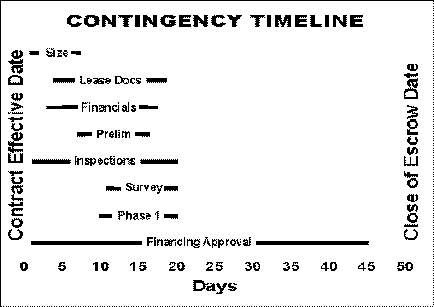
including financing. You can even draw up a timeline chart to be sure
that everything makes sense and is practical. A typical timeline chart
might look like this.
You should include in the contract that there can be no new leases, amendments
to existing leases, or waiver of terms of leases that impact the property
beyond the close of escrow date without buyer approval.
Possession Before or After Closing
If the seller will retain
possession of the property or any part thereof after the close of escrow or if
the buyer will get possession of the property or any part thereof before the
close of escrow, the parties should execute a formal lease agreement covering the
subject period of time. The lease agreement should be detailed and provide
for most, if not all, issues that would apply to a third-party tenant, including
maintenance and insurance issues as well as penalties for breach of the
lease.
If free rent is involved for pre-close possession
by the buyer, the seller might want to provide for
market rent beginning with the close of escrow date in the event that escrow
does not close on schedule, with the penalty rent paid in escrow. As the buyer, you will want to avoid such a rent penalty if possible. If free rent is
involved for post-close possession by the seller, you as buyer should provide
for market rent taking affect at the end of the expiration of the seller's
possession, as that will increase the probability of the seller leaving as
scheduled or compensate you in the event that he doesn't.
Final Check
Before you sign the contract, read it carefully and then read it
again. A signed real estate contract is a legally binding
agreement. The BIG print
giveth,
and the small print taketh
away. Most people, including brokers and attorneys do not read every word in a
contract because they assume the language is "standard." Handwritten or typed-in additions to any contract take priority when conflicts
exist in meaning. Ambiguities are held against the party that prepared the
documents. Cross out and initial any item that you wish to change.
For major changes use an addendum. When in doubt, don't sign - reconsider or
renegotiate.


|