|
Lesson 2
Cash Flow Analysis
A cash flow analysis is just what is says,
a look at how much positive (or negative) cash flow can be expected from a
property. It is not, by itself, really a valuation method, but is
useful fo r determining that the property is worth considering, taking
into
account the loan that you will require. Furthermore, the information
that must be gathered in order to do a cash flow analysis is also often
necessary for completing a full-blown valuation. For small income
properties, for example a single-family home or
duplex, it is more important because the value itself is usually based upon
the comparable sales rather than a method that will analysis income and
expenses. Most of the information required for a cash flow analysis is
also required for a formal valuation. r determining that the property is worth considering, taking
into
account the loan that you will require. Furthermore, the information
that must be gathered in order to do a cash flow analysis is also often
necessary for completing a full-blown valuation. For small income
properties, for example a single-family home or
duplex, it is more important because the value itself is usually based upon
the comparable sales rather than a method that will analysis income and
expenses. Most of the information required for a cash flow analysis is
also required for a formal valuation.
We will look at an example based on a typical
15-year-old 3-bedroom single-family home in Middle Town America. You
will often be able to find shabby looking examples listed for sale with your
favorite broker. Although the price range for our typical home will
vary substantially around the country, we will assume that (1) you are able
to skillfully negotiate a purchase price of $89,000, (2) you expect to
immediately spend an additional $6,000 for rehab, (3) closing costs,
including loan fees, will total $1,200, (4) your combined (federal + state +
local) marginal tax bracket is 22.5 percent, and (5) the rate of
appreciation in your area is 4.3 percent, the average rate over the past 10
years for the 60 largest markets. The rehab will include (1) upgrading
electric and plumbing, (2) painting, (3) re-carpeting, and (4) minor
repairs.
You can usually expect that most lenders will
require 25 to 30 percent down payment on known investment property, so we
will assume 30 percent. Even if the lender will make an 80 percent
loan, the property would then likely have a significant negative cash flow
in most rental markets. Accordingly, our total cash investment will be
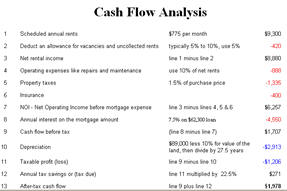
$33,900 ($26,700 + $6,000 + $1,200). The below table shows the remainder of assumptions
for our example and the results of our cash flow analysis. You can
also CLICK
HERE or on the picture of the table below to open the table
in a separate window. You may want to print the table so that you can follow
along with the lesson.
| 1 |
|
Scheduled annual
rents |
$775 per month |
$9,300
|
| 2 |
|
Less allowance
for vacancies & uncollected rents |
typically 5% to
10%, use 5% |
-420
---------
|
| 3 |
|
Net rental
income |
line 1 minus
line 2 |
$8,880
|
| 4 |
|
Operating
expenses like repairs and maintenance |
use 10% of net
rents |
-888
|
| 5 |
|
Property taxes |
1.5% of purchase
price |
-1,335
|
| 6 |
|
Insurance |
|
-400
---------- |
| 7 |
|
Net Operating
Income (NOI) |
line 3 minus
lines 4, 5 & 6 |
$6,257
|
| 8 |
|
Annual interest
on the mortgage amount |
7.5% on $62,300
loan |
-4,550
----------
|
| 9 |
|
Cash flow before
tax |
(line 8 minus
line 7) |
$1,707
|
| 10 |
|
Depreciation |
$89,000 less 10%
for value of the land, then divide by 27.5 yrs |
-$2,913
-----------
|
| 11 |
|
Taxable profit
(loss) |
line 9 minus
line 10 |
-$1,206
|
| 12 |
|
Annual tax
savings or (tax due) |
line 11
multiplied by 22.5% |
$271
|
| 13 |
|
After-tax cash
flow |
line 9 plus line
12 |
$1,978
|
| 14 |
|
Cash-on-cash
return |
line 13 divided
by cash invested $33,900 |
5.8%
|
| 15 |
|
Projected
one-year gain in value or sales price |
For initial
year:
price plus1/2 improvements =
$92,000 times 0.043 |
$3,956
|
| 16 |
|
Projected total
after-tax return for the first year |
Line 13 plus
line 15 |
$5,934
|
| 17 |
|
Total after-tax
overall rate of return for first year |
line 16 divided
by cash invested $33,900 |
17.5% |
|
When
you look at the chart you will see that lines 13 & 14 and lines 16
& 17 tell it all. On line 13, you have the annual after-tax cash
return that you can expect. Line 14 is the calculated rate of return
for the cash that you invest. Lines 16 and 17 tell you what your total
rate of return will be after taking into account the appreciation that
real estate investments have traditionally enjoyed.
|
Keep in mind that we could have picked
parameters so that the results came out to be anything we wanted.
However, we tried to use typical numbers so as to provide typical results.
The 5.8 percent cash-on-cash return isn't great, being about what CDs were
paying early in 2000, but looks good compared to CD rates at the time of
writing this when rates for multi-year CDs aren't much over 3 percent.
The total return, including appreciation, is however more interesting.
Our example produces a reasonable after-tax
return on your investment in rental property the first year, particularly
for a single-family house. Furthermore, the amount of annual interest
decreases each year and adds to your return. Finally, the cash flow
will increase in the future as rents increase and the overall rate of return
in future years should rise substantially because of inflation and leverage (30%
of your money moves 70% of the bank's money).
You may have realized that our rates of
return were lowered because we put $6,000 into the property at the time of
purchase. It seems that buying a property that didn't require this
additional investment would have provided better return. However, then
we would probably have had to pay more for it in the first place, requiring
a larger down payment and larger loan payments. Similarly, buying the
subject property and doing only absolutely necessary repairs (say $500
worth), but no improvements or upgrades, seems like it would improve the
returns. However, this would likely have resulted in lower rents.
The bottom line is that investing in real
estate is as much an art as a science and some decisions are simply a matter
of judgment that comes with experience. It is important that you
utilize analyses like that above to insure that your heart doesn't
override your brain and pocket book when selecting a property to buy.
Keep in mind that you did not get paid for
your work in finding, financing and then managing the property. Single
family rental housing investments may only make sense if you are willing to
work for little or nothing for the first few years that you own them.
However, for many investors with limited resources, they are the only game
in town. We also point out that this analysis shows why you should be
skeptical of claims made by many get rich quick real estate schemes.
There are a other ways to enhance your
after-tax return that are explored in detail in other areas of the e-course
or our Web site. However, if your investment doesn't come close to a
positive cash flow, without tax ramifications, it is probably best to keep
looking unless you can support the negative cash flow for a few years.


 |
|
|
