| This Is A Member-Only Page
| Can a tenant rent this |
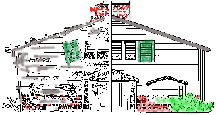 |
then demand this? |
Implied Warranty of Habitability Courts and common law had always agreed that, unless the lease provides otherwise, the landlord is obligated to deliver legal right to possess the premises to the tenant at the commencement of the lease term; but until recently, ... not really very much more. Right to possession The landlord has always warranted, by implication, that he has the legal right to give possession of the property to the tenant. He would violate this warranty if, for example, he had already given a lease on the property for the same period to someone else. But the courts were sharply split as to whether the landlord also implied a warrant that he would deliver actual possession at the start of the lease term; (the question usually arose when a prior tenant held over at the end of their lease.) Additionally, until the 1960s, a tenant was usually expected to accept a property "as is" and U.S. courts seldom held that a warranty of habitability could exist where none had been granted contractually. Premises rented as is Common law applied the principle of caveat emptor to landlord-tenant relationships. Unless the parties explicitly agreed otherwise the tenant took the premises as is. The landlord was not deemed to have made any implied warranty that the premises were fit or habitable, even in the case of a property intended to be inhabited. Nor did the landlord have any duty to repair defects to the property arising during the course of the lease, unless such duty was explicitly provided for. Occupant makes repairs The common law caveat emptor approach dated back to rural and agrarian economies when the tenant was interested principally in renting the land, not the structures on it. If repairs were necessary, he was expected to do them himself, since: (1) the buildings were simple uncomplicated structures; and (2) as a farmer, the tenant was expected to have the usual handyman abilities necessary to maintain the buildings, tools and equipment used by manual laborers and farmers. Common law placed additional obstacles in the path of any tenant who wished to hold his landlord accountable for the habitability of the premises. The common law followed the doctrine of independence of covenants in leases so that the breach of a covenant by one party would not relieve the other party of his duties (though he could sue for damages for the breach). This meant that even where the tenant had the bargaining power to obtain a clause providing that the landlord would make repairs on the premises, and keep them habitable, a breach of this covenant by the landlord would not relieve the tenant of the duty to pay rent. The tenant could sue for damages, but this was little comfort in view of the legal and emotional costs involved, and the fact that the tenant remained in uninhabitable living conditions while he sought judicial relief. Rent mitigated by maintenance The hardships of the common-law position were somewhat ameliorated by use of the constructive eviction doctrine. If the tenant could show that because of the landlord's failure to make repairs, the premises were rendered virtually uninhabitable, he could claim that he had been constructively evicted; his duty to pay rent would then cease, and he might be able to get damages as well. Another defense has sometimes been available where the premises were in violation of Building Code requirements at the time the lease was signed. This is the defense of illegality. Because of the general availability of the implied warranty of habitability in residential leases since the 1960s, however, the illegality defense, like the constructive eviction defense, is not often asserted. Courts abandon common law and judges legislate The modern court's view has made common law reasoning no longer applicable in most states, particularly regarding urban and suburban residential property. Many such leases are for units in apartment buildings. As one court noted, "in the case of the modern apartment dweller, the value of the lease is that it gives him a place to live. The city dweller who seeks to lease an apartment on the third floor of a tenement has little interest in the land 30 or 40 feet below, or even in the bare right to possession within the four walls of his apartment. When American city dwellers, both rich and poor, seek 'shelter' today, they seek a well known package of goods and services. A bundle which includes not merely walls and ceilings, but also adequate heat, light and ventilation, serviceable plumbing facilities, secure windows and doors, proper sanitation, and proper maintenance." Case studies The landmark case in the court's progression toward an implied warranty is Javins, Saunders, and Gross v. First National Realty Corp., 428 F.2d 1071 (D.C. Cir. 1970). In Javins, the Ts were residential tenants, whom L was seeking to dispossess on the grounds that they had defaulted in their rent. The Ts conceded the lack of payment, but asserted that the building contained hundreds of violations of the Washington D.C. Housing Regulations. The court concluded that, at least in cases of residential property, the landlord makes an implied warranty that the premises are habitable. A more recent example is in the Indiana Court of Appeals, January 22, 1997, Terri J. Johnson -vs.- Scandia Associates, Inc. Oxford Management Co. The Court implied that an implied warranty may not always exist, then later disclaimed their implication and narrowed their ruling to avoid setting a precedent on the broader issue of habitability, when they wrote:
"The question was not presented, and we did not decide in a footnote, whether the implied warranty of habitability can be expressly disclaimed in a residential lease. Accordingly, in order to avoid an extension of our holding beyond its reach, we have withdrawn the last sentence of footnote 3 in the opinion, which shall now read as follows:
We affirm this court's commitment in Breezewood Management to "support the reasonable expectations of the contracting parties whenever possible." Breezewood Management, 411 N.E.2d at 675 n. 2. We agree that "one who, 'with open eyes,' rents a hovel cannot later expect and sue for the Waldorf Astoria." Id. (Read the Opinion)
It is worth noting that the Michigan Supreme Court has further defined the so-called Covenant of Habitability by saying that "fit" premises are those containing all the "normal amenities", whatever that may include? Now it gets nuts There is this case from 2000: Is this the inevitable standard with respect to knowledge? "Just as a motorist is presumed to know the laws regulating motor vehicles, the court reasoned, so a landlord is presumed to know the requirements of the local housing code pertaining to the habitability of leased premises. Landlords need not inspect the premises before leasing, the court said, but because of the implied representation of habitability that accompanies the making of the lease, they fail to do so at their peril." (Benik v Hatcher 750 A2d 10 (Md Ct App. 2000). That kind of nutty reasoning would require a landlord to have expertise relating to every possible housing hazard, including but not limited to all aspects of construction, mechanicals, the presence of lead-based paint, asbestos and even mold in some obscure location. Shall states now require landlord education and testing prior to renting a home, as state law does for driving? That kind of onerous and expensive requirement would be the inevitable result of the court's reasoning in Benik v Hatcher. Back to more reasoned law Even when the traditional common law view was held that a landlord made no implied warranties that the premises were fit for habitation, or for any other particular purpose, there were several exceptions. Where the leased premises are furnished, and the lease is for a short period, courts have generally been willing to find that the landlord made an implied warranty that the premises and furniture are fit for use. Similarly, if a lease is made for a building that has not yet been completed, there would naturally be an implied warranty that it will be suitable for the tenant's intended use upon completion. Also, if the landlord fraudulently conceals defects from the tenant, the latter has always been able to get relief, either through rescission of the lease or damages. Since the 1960's, there has been an abrupt reversal of the age old general common-law caveat emptor position and now state after state has even sought to codify the concept by statute; (See NY State Law below) rationalizing that in spite of "as is" language in a contract, there still exists an implied warranty of habitability by virtue of the intended use of a dwelling and the business relationship of landlords and tenants. Similarly, in many states the tenant's duty to pay rent is now dependent upon the continued existence of buildings and improvements on the property, so that fire or flood could relieve them of any tenants obligations. Over forty five states now impose some sort of implied warranty of habitability. Where written law does not yet exist, courts are still likely to agree that if a property is rented for human habitation, it must be habitable. Although actual damages my now be awarded in case of a breach of an implied warranty, punitive damages for housing defects are allowed in warranty of habitability cases - only if there is clear, unequivocal, and convincing evidence that the landlord's conduct was motivated by malice or so reckless and/or grossly negligent as to reach the level of "criminal disregard" for the tenant's health and safety. Interestingly, the U.S. Government definition of substandard housing would lead one to believe that even the worst hovel could qualify as decent and safe. Take a moment and read: Substandard Housing Defined (1) Warranty of Habitability codified by statute in the State of New York
New York State Consolidated Laws
Real Property
ARTICLE 7
Landlord and Tenant
Section. 220. Action for use and occupation.
S 235-b. Warranty of habitability. 1. In every written or oral lease or rental agreement for residential premises the landlord or lessor shall be deemed to covenant and warrant that the premises so leased or rented and all areas used in connection therewith in common with other tenants or residents are fit for human habitation and for the uses reasonably intended by the parties and that the occupants of such premises shall not be subjected to any conditions which would be dangerous, hazardous or detrimental to their life, health or safety. When any such condition has been caused by the misconduct of the tenant or lessee or persons under his direction or control, it shall not constitute a breach of such covenants and warranties. 2. Any agreement by a lessee or tenant of a dwelling waiving or modifying his rights as set forth in this section shall be void as contrary to public policy. 3. In determining the amount of damages sustained by a tenant as a result of a breach of the warranty set forth in the section, the court;
(a) need not require any expert testimony; and
(b) shall, to the extent the warranty is breached or cannot be cured by reason of a strike or other labor dispute which is not caused primarily by the individual landlord or lessor and such damages are attributable to such strike, exclude recovery to such extent, except to the extent of the net savings, if any, to the landlord or lessor by reason of such strike or labor dispute allocable to the tenant's premises, provided, however, that the landlord or lesser has made a good faith attempt, where practicable, to cure the breach.
Return to top | Go to Landlord tenant Law | Substandard Housing Defined
|