| This Is A Member-Only Page Construction and/or rehabilitation of rental housing
In a free market, the cost of producing goods or services has little or nothing to do with its ultimate value. For example: a masterpiece, a rare stamp, a homerun by a super star, or a performance by a symphony orchestra. The analogy is particularly true in real estate where the three things that most affect value are location, location and location. When a builder targets a home buyer he must select a location which will add value to his cost of construction in order to make a profit. A 1,200 sq. foot home on a $30,000 lot will cost about $102,000. The finished product must have a value higher than that for the developer to stay in business. Fortunately people are willing to pay more for a home they like, in a desirable location, than it actually costs to produce.
Income property is different. When a commercial or investment property appraiser is asked to put a price on real estate, they must use three approaches to value in order to reach their conclusion. Replacement Cost, Market Data Approach and Income. The first two are considered factors, but the most important–by far–is how much income the property will produce. The annual Net Operating Income (gross rents - less, taxes, insurance, maintenance and vacancy) is divided by a capitalization rate (the cost of funds)
Because of higher real estate prices and higher wages, coupled with municipal government fees and regulations, the cost of construction in urban areas is much higher than comparable buildings in suburban or rural locations. However, rents everywhere are dependent upon tenants ability to pay, which is a factor of the median household income in the location.
A new two bedroom rental unit targeted at the median household income of a metro area might only rent for about $370 in the city, $475 in the suburbs and $425 in a rural location. Since construction costs are now at least $65 per foot, it is foolhardy to construct a 900 sq. foot unit which can only produce enough income to support value of between $30 and $45. As a result, new rental housing must be subsidized in order to be affordable to median income tenants. Although Section 8 has made it possible for some low income tenants to compete for quality units, communities are rising the standards and costs for existing housing which has made it even more difficult for most lower wage working families.
As seen here, value relative to possible rents from new or renovated rental housing, targeted to low to moderate income families, has reached crisis proportions. Additionally, Congress has shifted funding from expensive and crime ridden subsidized public housing projects to individual Section 8 certificates and vouchers, encouraging low income families to seek and compete for the best possible rental value in the private sector and shutting out tenants who have not yet won the social services lottery and received a Section 8 subsidy. 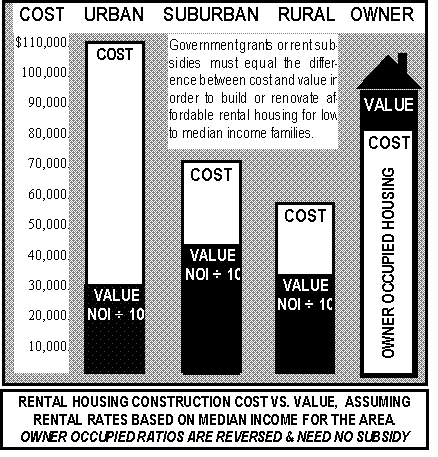
It is obvious from the numbers on the chart above that low wage families without subsidies will be unable to find affordable housing unless cooperative efforts are begun between landlords and the community to address the problem.
There is limited rental housing that poor renters can afford. Only 1.9 million vacant rental units have rents low enough to alleviate cost burdens for the 5.3 million poor renters, including about 1 million elderly households, who are currently paying more than 50 percent of their incomes on rent, and/or live in severely substandard homes.
Seventy-seven percent of all older renters with incomes at or below the poverty level spend at least 30 percent of their incomes on housing, while 48 percent spend 50 percent or more of their incomes on housing. |